
The main role of a hardware TPM entails secure storage, key administration, and attestation. The PSA Root of Trust (PSA-RoT) was developed specifically for IoT and designed to assist developers looking to cost-effectively implement IoT security, even on low value microcontrollers. It provides an easy-to-use security element applied by many of the world’s leading chip vendors. The PSA-RoT is usually provided by the chip vendor and built-in in their Software Program Growth Kits. It is accessible to platform and gadget software through a high degree, easy-to-use software program interface and consists of 9 safety functions designed to deal with 10 key security targets.
What Are The Types Of A Silicon-based Hardware Root Of Trust?
Last up to date on April eight, 2025 A root of trust is the security basis for an SoC, other semiconductor gadget or digital system. From our perspective, the hardware root of belief contains http://www.leonardpeltier.info/security-alarm-systems/ the keys for cryptographic features and is normally part of the secure boot process providing the foundation for the software chain of trust. Root of Belief schemes generally include hardware hardening technologies like a hardware safety module (HSM).
Man-in-the-middle (mitm) Attacks
- When selecting a Root of Belief solution, it’s important to ask the best questions to make sure the most effective stage of protection in your specific safety needs.
- Public and private keys throughout the TPM are utilized for various cryptographic operations, attestation, and data safety, contributing to the overall safety of the platform.
- The Foundation of Trust (RoT) is a secure and trusted starting point constructed into hardware or firmware that types the muse for all safety operations in a tool.
- Therefore, no ancestor entity can present a trustable attestation (in digest or otherwise) for the Root-of-Trust’s initial code and data state.
Suppose this root all of a sudden collapses or an attacker finds a way to breach it, then every layer from the top, together with person credentials to encrypted knowledge and from applications to operating systems, can be compromised without any alerts. This creates probably the most devastating type of cybersecurity risk – the Root of Belief (RoT) attacks. A TEE running on a system without Secure Boot offers no real assure — the TEE firmware itself might be compromised. Safe Boot without a hardware RoT means the verification keys could probably be tampered with. A designer of a related fridge might determine that a PSA Licensed Stage 2 chip is appropriate, in the occasion that they choose to make use of unique keys per system, as this would shield them from the first risk of a distant software attack.

Safe Key Protection
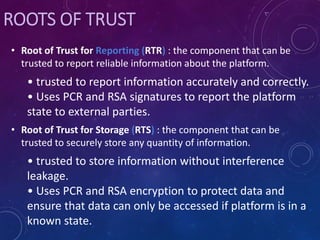
The Root of Trust is definitely built-in with industry-standard interfaces and system architectures and consists of normal hardware cryptographic cores. Entry to crypto modules, keys, memory ranges, I/O, and different sources is enforced in hardware. Important operations, together with key derivation and storage, are performed in hardware with no access by software program. The Foundation of Belief is predicated on a customized 32-bit processor designed particularly to offer a trusted basis for secure processing on chip and within the system. A hardware root of trust is the foundation on which all safe operations of a computing system rely.
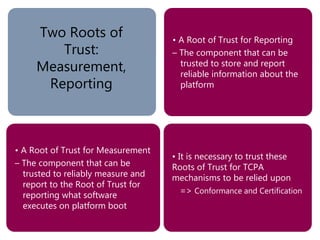
Root of Belief is turning into more and more essential as using Internet of Things (IoT) units becomes more and more frequent. To thwart hacking attempts, parts of computing techniques and linked mobile devices want a approach to confirm if the data they are receiving is genuine. The IoT Root of Trust helps construct belief in the entire computing ecosystem by safeguarding the safety of data and purposes within it.
